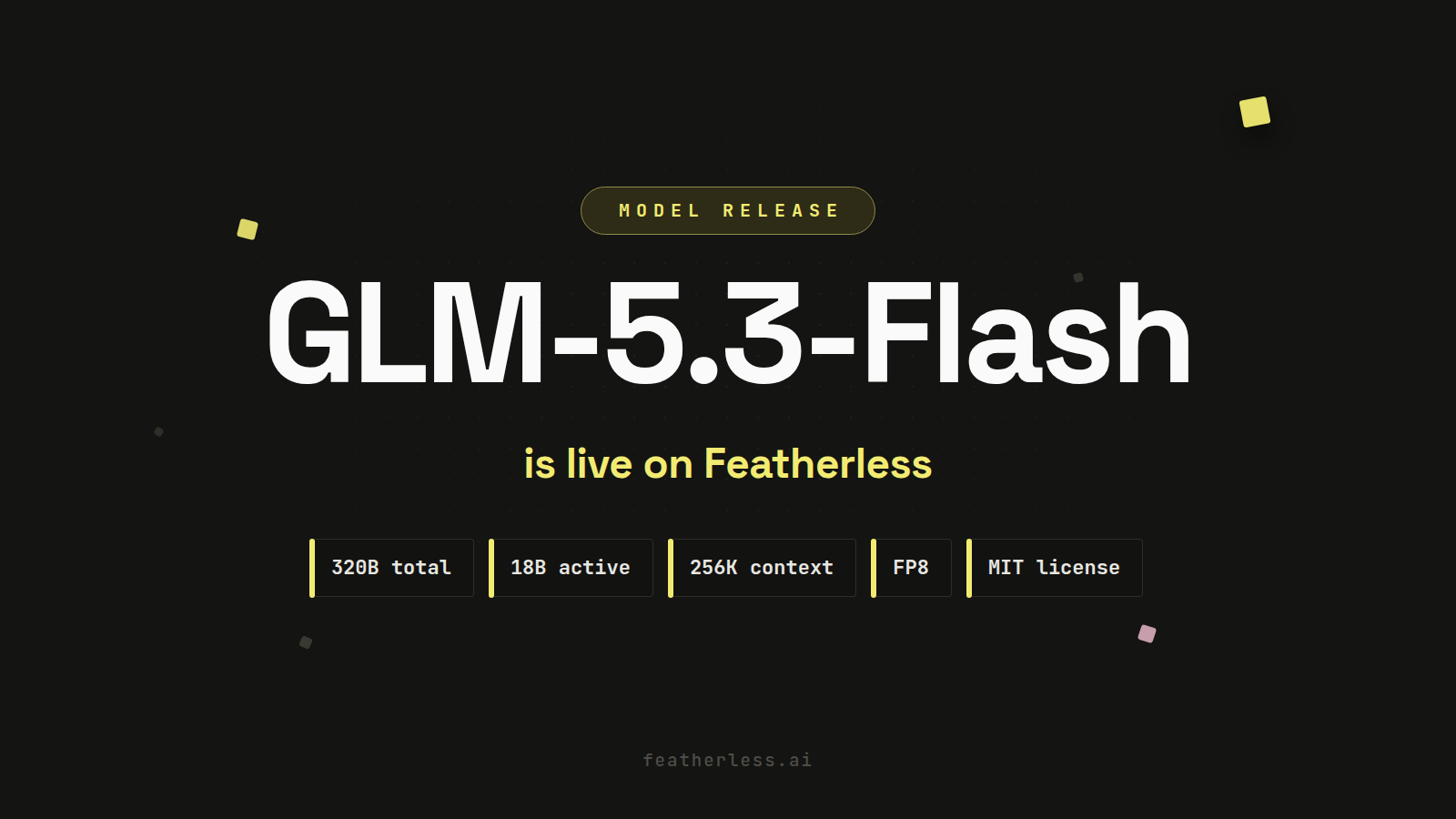
Z.ai just confirmed that ox-alpha, the stealth model that took over OpenRouter’s coding charts, was GLM-5.3-Flash. It’s a 320B natively multimodal model under an MIT license, and Z.ai served the entire preview on Chinese AI chips. Live on Featherless.
What changed from GLM-5.2
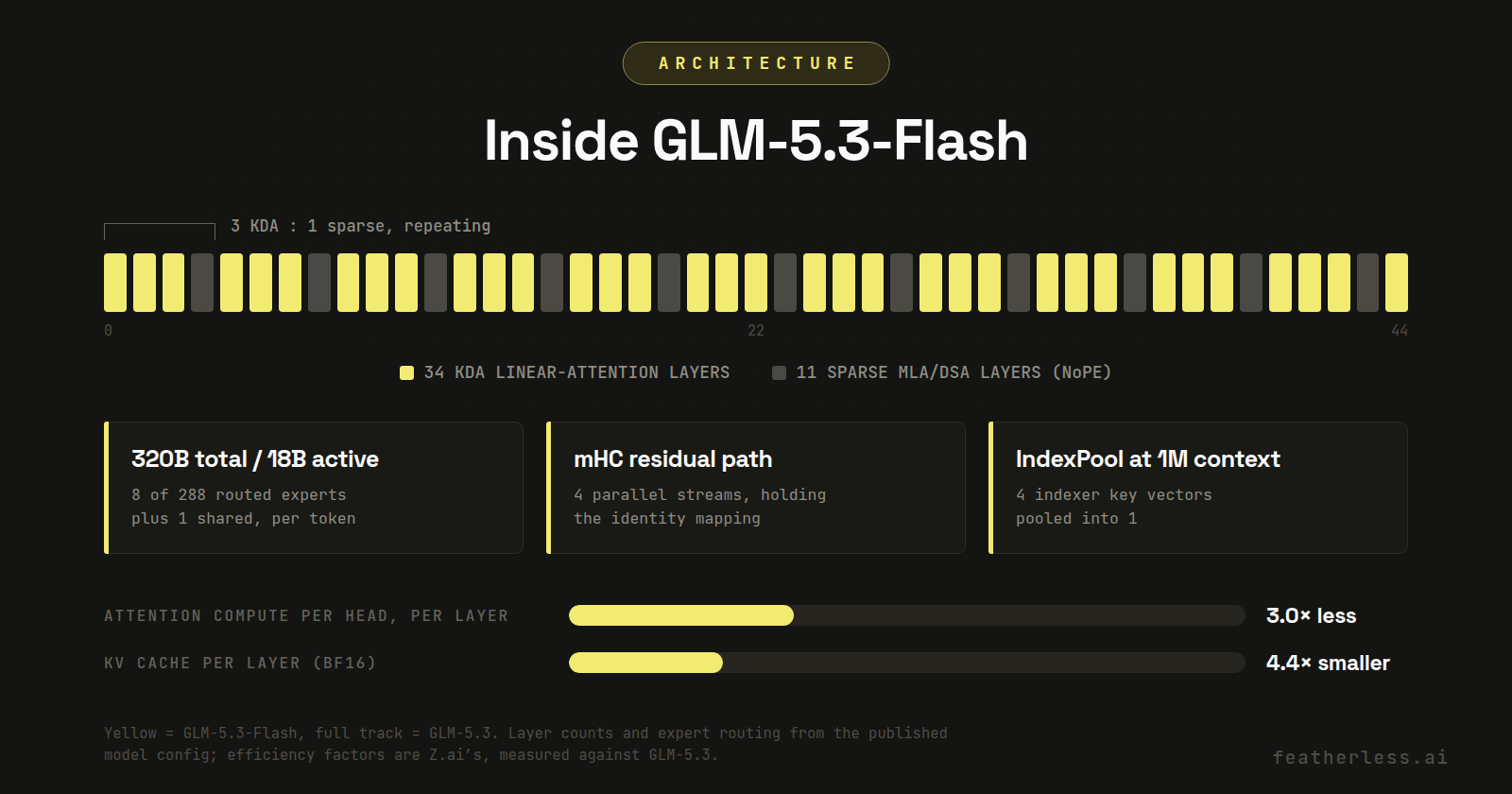
It's the first open-weight, natively multimodal model in the GLM-5 series. Z.ai’s own comparison is against GLM-4.5: similar total size at 320B vs 355B, but roughly half the active parameters (18B vs 32B) and half the layers (45 vs 92). Each token routes through 8 of 288 experts plus one shared expert. Against GLM-5.2, the claim is quality and price at once: Z.ai reports it beats GLM-5.2 across their benchmark suite at one-tenth the price.
The architecture is where the cost went. This is the first GLM model to mix linear and sparse attention in the same stack: linear attention handles local dependencies through state modeling, while sparse attention retrieves global context through a lightweight indexer. At a 1M-token context the indexer itself becomes the bottleneck, so Z.ai added IndexPool, which compresses four indexer key vectors into one. They also adopt Manifold-Constrained Hyper-Connections (mHC) for scaling efficiency. Measured against GLM-5.3, Z.ai reports 3.0× less attention compute and a 4.4× smaller KV cache.
Pre-training ran on a 30T-token multimodal corpus, so vision is native. The model reads images and video directly, and Z.ai built the visual training around self-verification: the model renders its own frontend output, looks at it, and fixes the layout.
The numbers
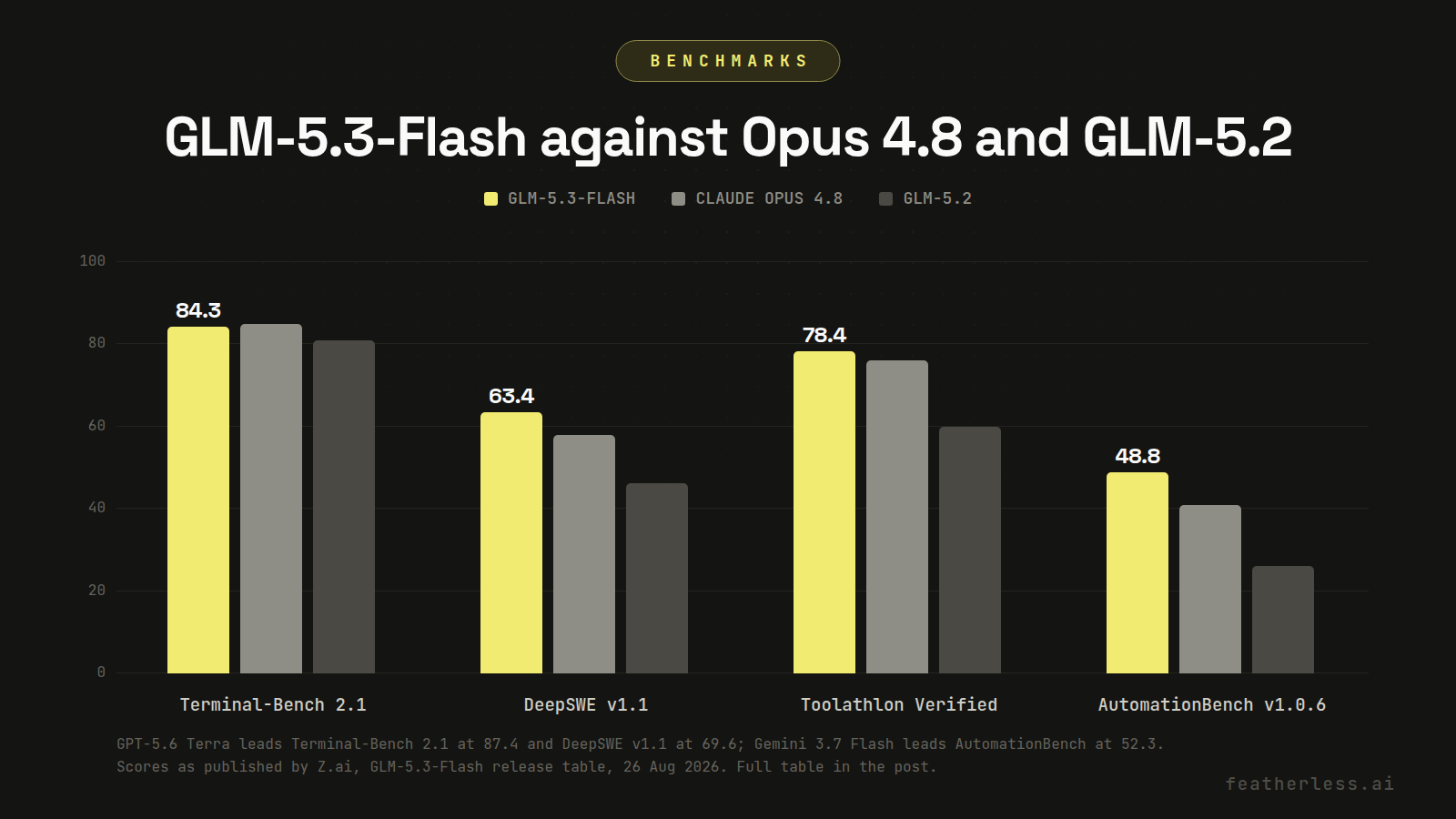
Z.ai’s table puts GLM-5.3-Flash at 84.3 on Terminal-Bench 2.1 against Claude Opus 4.8’s 85.0, and ahead of Opus on DeepSWE v1.1 (63.4 vs 58.0) and Toolathlon Verified (78.4 vs 76.2). Vision holds up: 62.4 on OfficeQA Pro against Opus 4.8’s 48.9, and 78.0 on Chartography against 75.0. GPT-5.6 Terra still leads on Terminal-Bench at 87.4. You can read Z.ai’s full benchmark table here.
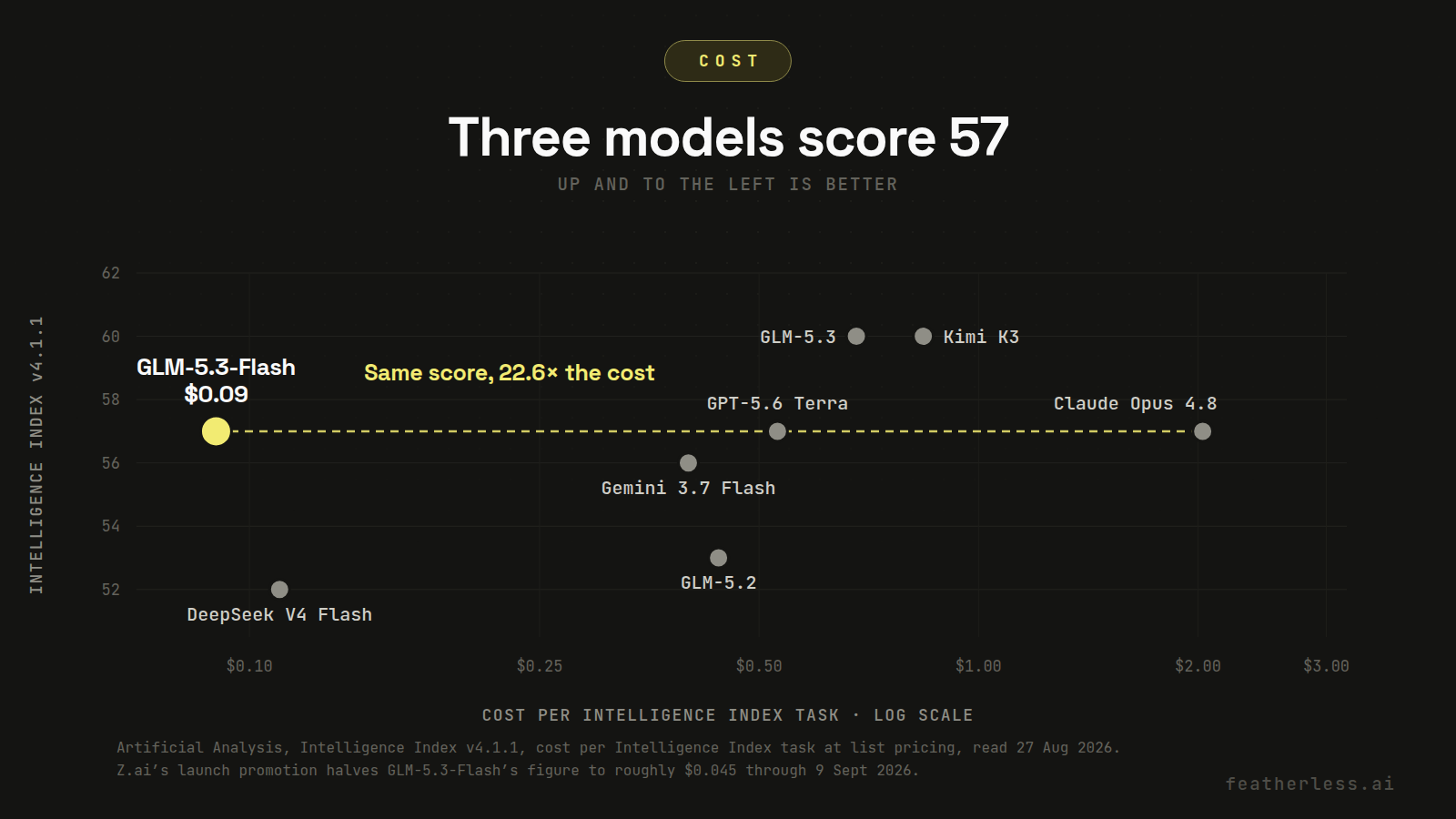
Two numbers come from outside Z.ai. Artificial Analysis scores GLM-5.3-Flash at 57 on its Intelligence Index v4.1.1, and puts the cost of running that index at $0.09 per task. Claude Opus 4.8 scores the same 57 and costs $2.03 per task, 22.6× more. Z.ai’s own post quotes $0.045, which is that same figure under its 50%-off launch promotion, running to September 9. Artificial Analysis also ran GDPval-AA v2, where GLM-5.3-Flash scores 1773 against Opus 4.8’s 1582 and GPT-5.6 Terra’s 1571.
Three caveats worth keeping straight. Z.ai Code Bench is Z.ai’s in-house eval. “Flash” is a price tier and not a speed claim — Artificial Analysis measures 50.2 output tokens per second, mid-pack for the class. And Opus 4.8, the model Z.ai benchmarks against, is one Artificial Analysis now marks deprecated in favour of Opus 5, which it scores at 63. For third-party numbers, check the leaderboard from Arena AI.
The full table, as Z.ai published it
| Benchmark | GLM-5.3-Flash | GLM-5.2 | DeepSeek-V4-Vision-Exp | Opus 4.8 | GPT-5.6 Terra | Gemini 3.7 Flash |
|---|---|---|---|---|---|---|
| Coding | ||||||
| Terminal-Bench 2.1 | 84.3 | 81.0 | 83.9 | 85.0 | 87.4 | 85.8 |
| DeepSWE v1.1 | 63.4 | 46.2 | 59.3 | 58.0 | 69.6 | 65.3 |
| NL2Repo | 56.3 | 48.9 | 57.7 | 69.7 | — | — |
| Agentic | ||||||
| Toolathlon Verified | 78.4 | 59.9 | 75.9 | 76.2 | 74.9 | — |
| AutomationBench v1.0.6 | 48.8 | 26.2 | 38.8 | 41.0 | 37.2 | 52.3 |
| Agents’ Last Exam | 26.3 | 20.4 | 27.3 | 27.0 | 28.0 | — |
| HLE with tools | 55.3 | 54.7 | 55.1 | 57.9 | — | — |
| GDPval-AA v2 | 1773 | 1504 | 1675 | 1582 | 1571 | 1527 |
| Vision | ||||||
| OfficeQA Pro | 62.4 | — | 57.9 | 48.9 | — | — |
| CharXiv Reasoning, with tools | 89.4 | — | 80.4 | 89.9 | 88.0 | 88.7 |
| Chartography, with tools | 78.0 | — | 64.3 | 75.0 | 68.0 | 65.0 |
| BabyVision | 53.4 | — | 35.1 | 46.8 | 61.6 | 70.9 |
| MVBench | 77.8 | — | 69.4 | 67.1 | 75.0 | 82.2 |
| MMVU | 80.5 | — | 72.7 | 67.4 | 75.8 | 82.3 |
Every figure above is Z.ai’s, from the GLM-5.3-Flash release post. Dashes are unpublished, not zero. All rows are percentages except GDPval-AA v2, which is an Elo-derived score and is run by Artificial Analysis rather than Z.ai.
How to run GLM-5.3-Flash
Currently on Featherless, GLM-5.3-Flash serves at: 256K context, FP8 quantization, tool calling enabled. The model’s native window is 1M tokens, and we’re working to expand ours toward it.
GLM-5.3-Flash runs on the same LLM calling API developers already know and use, the OpenAI-compatible API. It’s the same as the other thousands of models we host on our site.
from openai import OpenAI

client = OpenAI(
    base_url="https://api.featherless.ai/v1",
    api_key="YOUR_FEATHERLESS_KEY",
)

response = client.chat.completions.create(
    model="zai-org/GLM-5.3-Flash",
    messages=[
        {
            "role": "user",
            "content": "Refactor this Flask route to run async.",
        }
    ],
    extra_body={"reasoning_effort": "max"},
)

print(response.choices[0].message.content)
One knob worth knowing: reasoning_effort takes low, high, or max, and defaults to max. Drop it to low when you want the price tier to actually behave like one.
It’s that simple.
And, as is the same with all of your api calls on featherless, no logs, so your prompts and completions stay yours.
So what are you waiting for?
Try it out today – https://featherless.ai/models/zai-org/GLM-5.3-Flash
Going beyond
Are you interested in running GLM-5.3-Flash at even larger scales, or at its full 1M context? Are your unpredictable per-token bills exploding? Check out our dedicated gpu clusters, where our team can help tune the full inference stack exactly for your needs, including quantization, batching, fine-tuning, and whatever else you need. We have GPUs, and you need compute. Learn more below, and feel free to schedule a call, where we’ll help tackle your biggest AI problems.
Related articles
Start building under 3 minutes