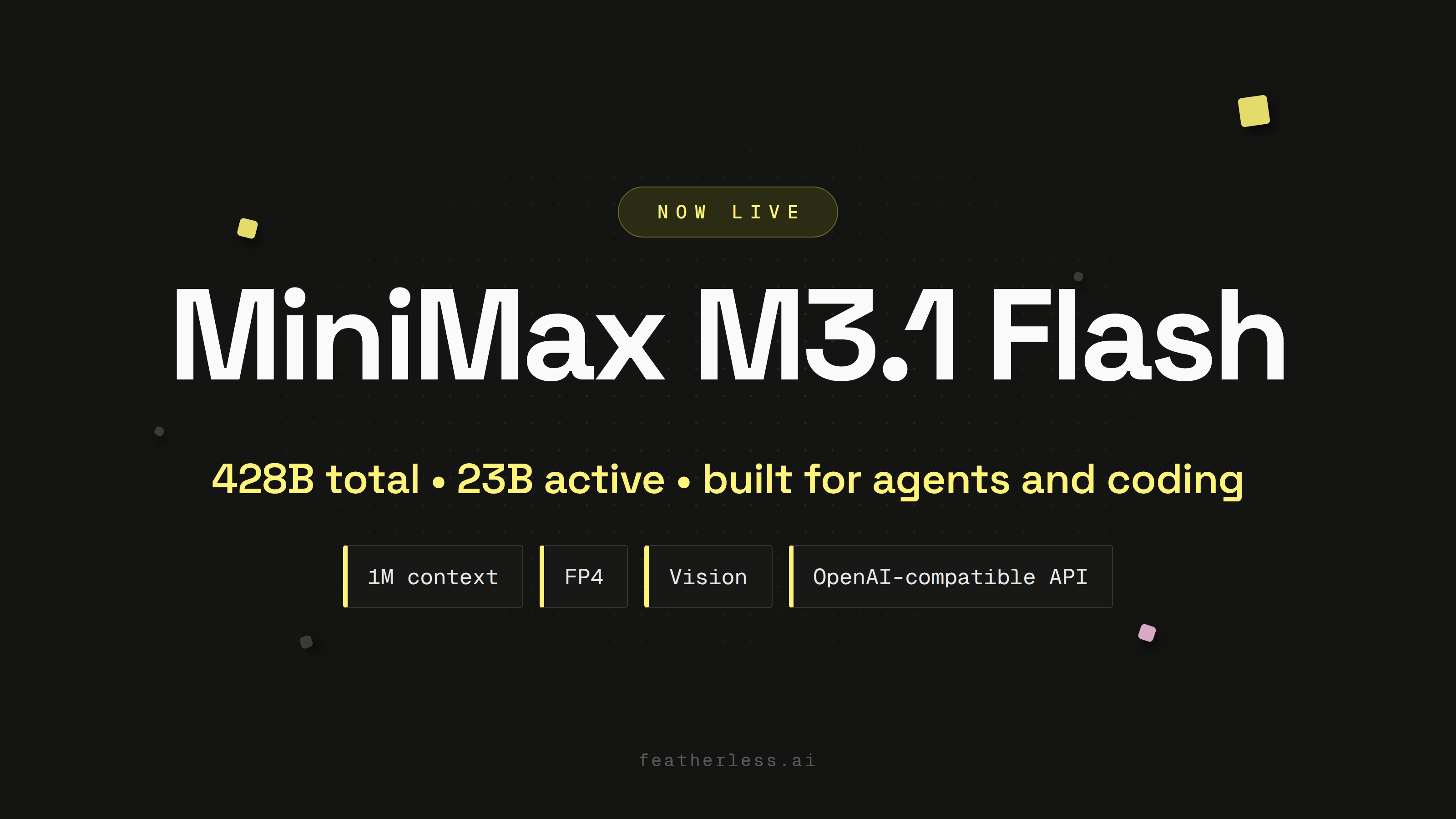
MiniMax released the open weights for MiniMax M3.1 Flash today: 428B total parameters with 23B active per token, built for coding, agentic workflows and computer use. Artificial Analysis scores it 42 on its Intelligence Index at $0.22 per task, less than half the cost of MiniMax M3. It is live on Featherless now at 1M context in FP4.
What’s new
You may have already used it. Before launch, an earlier version of MiniMax M3.1 Flash ran anonymously as “Space Bunny” and topped public usage leaderboards, serving 200T+ tokens before anyone knew whose it was.
M3.1 Flash keeps M3’s mixture-of-experts design and changes three things, all aimed at the cost of serving it. Sparse attention now runs through the whole model, replacing M3’s first three full-attention layers. The experts and attention paths were quantized during training, so the model learned to work at 8-bit precision rather than being compressed after the fact. And a new DSpark draft head speeds up generation through speculative decoding.
MiniMax says the result runs at about a third of M3’s price and three times its speed. It takes text, image and video input, with a native 1M-token context window.
MiniMax points it at four kinds of work:
- Coding agents. Resolving real software engineering tasks end to end in a repository.
- Agentic workflows. Working through realistic business processes across tools, files and apps.
- Computer use. Operating desktop applications from what is on the screen.
- Security work. Finding and reproducing vulnerabilities in real codebases.
The full model card, with every evaluation setting, is on Hugging Face, and the attention design is in MiniMax’s MiniMax Sparse Attention paper.
The numbers
Artificial Analysis has already measured it. MiniMax M3.1 Flash scores 42 on the Intelligence Index, 13 points above MiniMax M3, and costs $0.22 per task to run the full evaluation, against $0.51 for M3. That puts it level with GLM-5.3-Flash at a lower cost per task, and just behind DeepSeek V4.1 Flash 1017 at 45. Its biggest jump is in hard reasoning: 48% on Humanity’s Last Exam, up from 39% for M3. (Artificial Analysis)
That is the trade: not the top of the index, but frontier-class agent work for a few cents a task.
MiniMax’s own launch results, run on their published harnesses:
- AutomationBench v1.0.6: 62.8% (agents on realistic business workflows)
- DeepSWE v1.1: 73.7% (agentic software engineering)
- OSWorld 2.0: 61.7% (computer use)
- CyberGym: 82.2% (security vulnerability tasks)
- BabyVision, with tools: 91.0% (visual reasoning)
Source: MiniMax’s M3.1 Flash model card. Scores are self-reported by MiniMax.
How to run MiniMax M3.1 Flash
On Featherless, MiniMax M3.1 Flash serves at 1M context with FP4, with vision enabled. We worked with MiniMax ahead of launch to tune our serving stack for this model.
It runs on the same OpenAI-compatible API developers already use, the same one that serves the other 40,000+ open models we host.
from openai import OpenAI

client = OpenAI(
    base_url="https://api.featherless.ai/v1",
    api_key="YOUR_FEATHERLESS_KEY",
)

response = client.chat.completions.create(
    model="MiniMaxAI/MiniMax-M3.1-Flash",
    temperature=1.0,
    top_p=0.95,
    messages=[
        {
            "role": "user",
            "content": "Our nightly ETL job writes orders to the warehouse, but on days with more than 50,000 orders some rows appear twice. The job reads from a paginated API sorted by created_at, 1,000 rows per page. What is the most likely cause, and how would you fix it without slowing the job down?",
        }
    ],
)

print(response.choices[0].message.content)
MiniMax recommends temperature=1.0 and top_p=0.95, as in the example above.
If you already run MiniMax models in Cline, Kilo Code, OpenCode or Hermes Agent, switching is three settings: your Featherless key, the base URL above, and the model ID MiniMaxAI/MiniMax-M3.1-Flash.
And, as with all your API calls on Featherless, there are no logs, so your prompts and completions stay yours.
Try MiniMax M3.1 Flash today → https://featherless.ai/models/MiniMaxAI/MiniMax-M3.1-Flash
Going beyond
Running agents on MiniMax M3.1 Flash at serious volume? Is your per-token bill growing faster than your usage? Our dedicated GPU clusters give you a fixed monthly cost, and our team tunes the full inference stack for your workload: quantization, batching, fine-tuning and whatever else you need. Schedule a call and we’ll help you tackle your biggest AI problems.
Get Dedicated GPU at $7.6k/month → https://featherless.ai/lp/dedicatedgpu
Related articles
Start building under 3 minutes