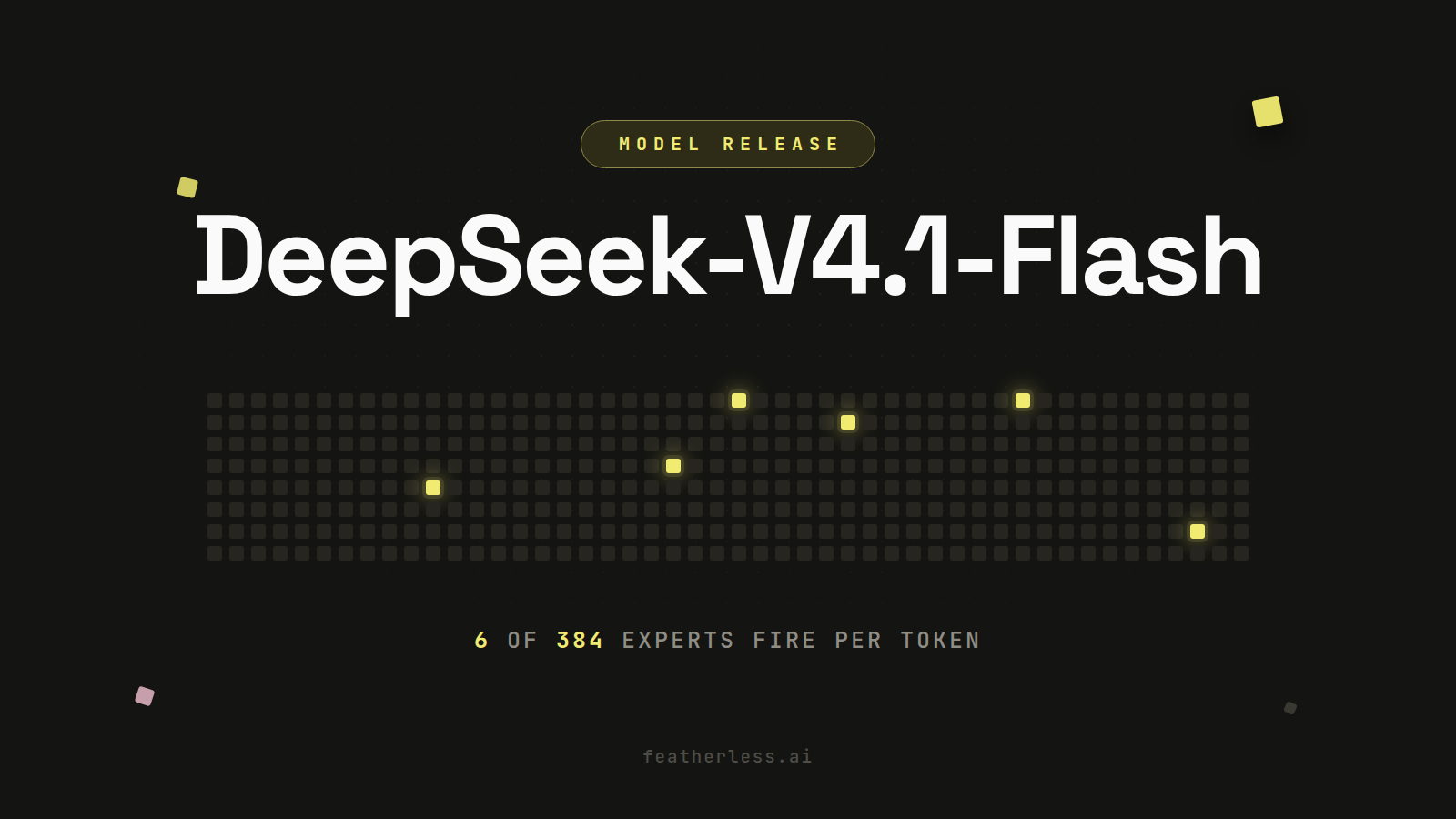
DeepSeek shipped V4.1-Flash on September 10: 763B total parameters with 8B active at prefill and 16B at decode, natively multimodal, under an MIT license. The same day the company retired V4-Flash and V4-Flash-Vision-Exp, temporarily routing both model names to V4.1-Flash. It is live on Featherless at 256K context on the Developer plan.
What changed from V4-Flash
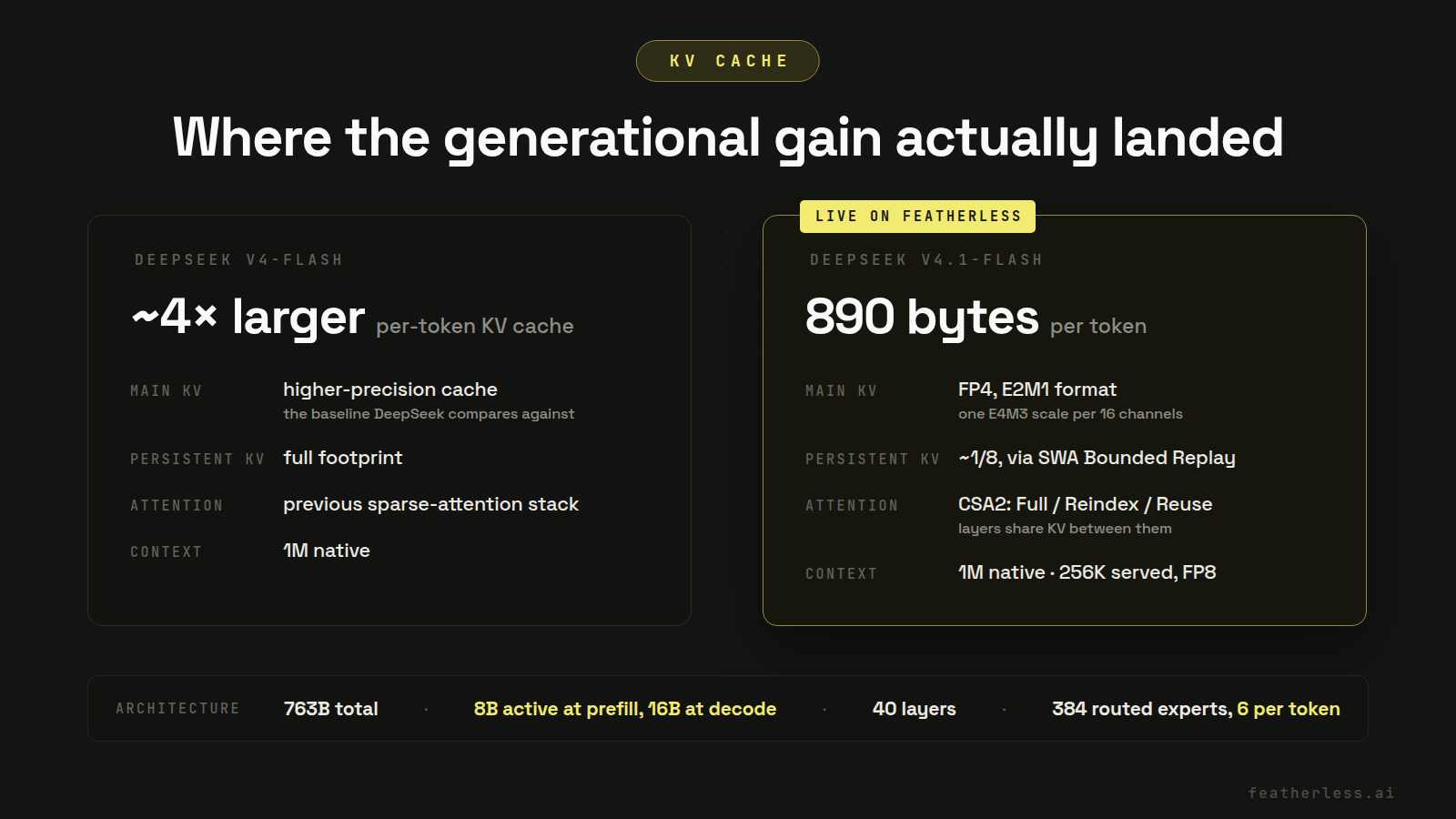
DeepSeek’s model card compares against V4-Flash, the model it replaces, and the gain is in memory rather than size. V4.1-Flash caches main KV in FP4, using the E2M1 format with one E4M3 scale per 16 channels, which brings the KV cache down to 890 bytes per token, roughly a quarter of what V4-Flash needed. A second mechanism, SWA Bounded Replay, cuts the persistent KV cache to about an eighth.
The rest of the stack is new too. The backbone is a Causal Encoder-Decoder with 40 layers split evenly into 20 encoder and 20 decoder layers. Compressed Sparse Attention 2 assigns each layer a Full, Reindex or Reuse mode so that layers share KV between them instead of each keeping its own. Every MoE layer holds one shared expert and 384 routed experts, six of which activate per token. A separate 196B-parameter Engram conditional memory sits outside the backbone and is read sparsely by token lookup. Pretraining ran on 45T multimodal tokens, with sparse attention trained at 64K and extended to the full 1M window over the final 34T.
It is natively multimodal, taking images and text in and generating text out, through a DeepSeek-ViT encoder trained with 2D-RoPE and 3×3 pixel-unshuffle downsampling.
The numbers
DeepSeek’s own table, measured at max reasoning effort, against Claude Opus 5.0 and GPT-5.6 Sol:
Artificial Analysis has measured the model independently, which is more than most open releases get in their first week. It scores 40 on Intelligence Index v4.3, sixth of 113 models, and 212.1 output tokens per second, fourth of 113 for speed, with a 1.19-second time to first token.
How to run DeepSeek-V4.1-Flash
Currently on Featherless, DeepSeek-V4.1-Flash serves at 256K context with FP8 quantization. The model’s native window is 1M tokens, and we’re working to expand ours toward it.
It runs on the same OpenAI-compatible API that developers already use, the same one that serves the other 40,000+ open models we host.
from openai import OpenAI

client = OpenAI(
    base_url="https://api.featherless.ai/v1",
    api_key="YOUR_FEATHERLESS_KEY",
)

response = client.chat.completions.create(
    model="deepseek-ai/DeepSeek-V4.1-Flash",
    messages=[
        {
            "role": "user",
            "content": "Read this repo’s failing CI log, find the flaky test, and write the patch.",
        }
    ],
)

print(response.choices[0].message.content)
If you are wiring this into a coding agent, our Kimi K3 agent guide walks through the context compaction settings tool by tool.
Per-token rates are $0.30 per 1M input tokens, $0.03 per 1M cached input, and $1.20 per 1M output. That matches DeepSeek’s own peak-hours price on input and output. Tokenomics 101 covers how to work that out for a real workload.
And, as is the same with all of your api calls on featherless, no logs, so your prompts and completions stay yours.
Try it out today – https://featherless.ai/models/deepseek-ai/DeepSeek-V4.1-Flash
Going beyond
Are you interested in running DeepSeek-V4.1-Flash at even larger scales, or at its full 1M context? Are your unpredictable per-token bills exploding? Check out our dedicated gpu clusters, where our team can help tune the full inference stack exactly for your needs, including quantization, batching, fine-tuning, and whatever else you need. We have GPUs, and you need compute. We did this for GLM 5.2 on four MI325X GPUs and cut an agent workload that would have run about $150K a month in Opus bills down to $7,592, so the arithmetic is not hypothetical.
Get Dedicated GPU at $7.6k/month → https://featherless.ai/lp/dedicatedgpu
Related articles
Start building under 3 minutes