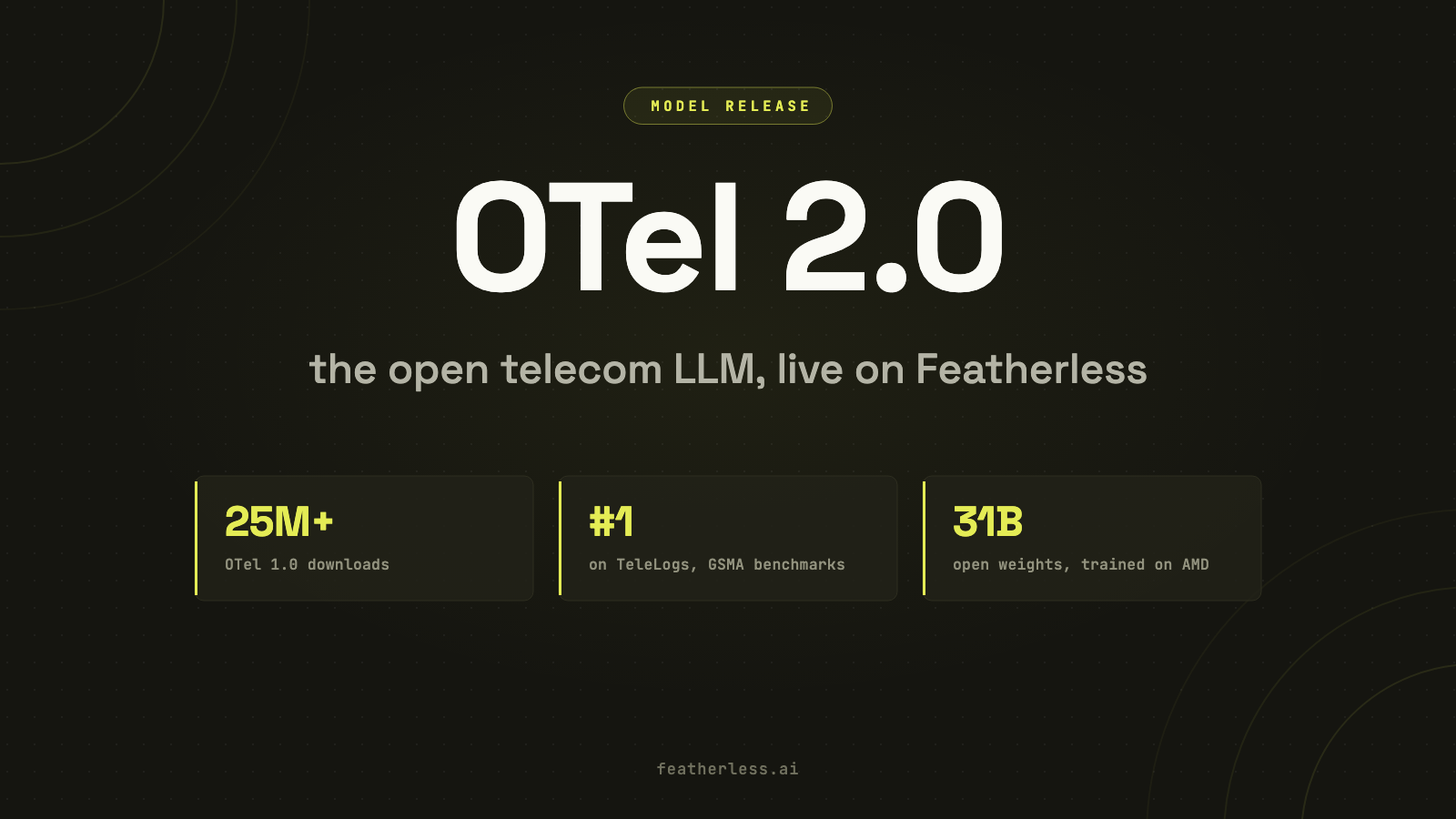
Recently, AT&T, together with Microsoft and AMD, released OTel 2.0: an open large language model built for the telecommunications industry. It reads 3GPP and ETSI specifications, interprets GSMA standards, and handles the network-engineering work that general-purpose models get subtly wrong. It is open, and the full family is live on Featherless today. We are proud to be a launch partner. But the significance is not that one more model came online, it’s that one of the world's largest companies just demonstrated, in public and at scale, where enterprise AI is actually going: specialized, and open. OTel 2.0 is merely just the beginning.
For two years the standard advice has been to reach for the largest frontier model and never build your own. OTel is what happens when an industry with real volume ignores that, and it is telling that telecom went first. This is because telecom is one of the very few industries whose technology can be described as “open”. A network has no value unless it is compatible with any other network in the industry, therefore telecom had a natural reason to create shared standards. It has published its playbook in the open for decades, through bodies like 3GPP, ETSI and the GSMA, so the corpus to train a telecom model already existed, and an industry that shares its foundations is comfortable sharing the model built on them. OTel was post-trained on Gemma 4, an open model, on those open standards rather than on proprietary secrets. Fittingly, it comes from AT&T, whose Bell Labs gave the world the transistor, information theory, and UNIX and then licensed them out. For AT&T, open foundational technology is not a departure. It is a return to form.
What matters is that it wins where it counts. It’s an open model built for one industry rather than all of them, live on Featherless today for anyone to access. In the GSMA's own Open-Telco LLM Benchmarks, AT&T's fine-tuned model posted the top score on TeleLogs, the network troubleshooting task, ahead of much larger generalist models. Frontier models still lead the broad leaderboards, but the point is the specialization, on the operational work a carrier actually runs, the specialized model wins. The volume of how much this model was served is also worth highlighting. OTel 1.0 was downloaded more than 25 million times before 2.0 shipped, and 2.0 was trained at production scale on AMD rather than Nvidia hardware. If an industry as old and robust as the telecom industry got this specialization, the obvious question is which industry is next.
To talk more about specialized AI and where this is headed globally, beyond just the telecom industry, Anthropic released some research earlier in the year mapping exactly which industries AI shows up in the most. The most common industries were software, administration, and finance. Some of the least used industries were transportation, construction, and agriculture. In America alone, the latter 3 cumulatively represent roughly 2.5 trillion dollars each year in economic activity. Every one of those industries runs on deep, specialized knowledge: equipment manuals, safety codes, logistics, regulations, and so on. This is truly where a smaller, faster, more specialized model can shine, in the exact same way OTel 2.0 has shown.
At Featherless, being able to support anyone who wants to build in more specialized domains is core to our mission. We believe that OTel 2.0 is merely just the beginning of what will be a proliferation and rise in specialized AI models. Our goal is to serve the long tail of models, the specialized, niched, often forgotten about models and domains of the world. We strongly believe that pattern will continue to accelerate, specific models for specific domains, fine-tuned, and we’re making a bet on that accordingly.
Are you interested in testing out these niche models? Give it a whirl on Featherless today.
Related articles
Start building under 3 minutes