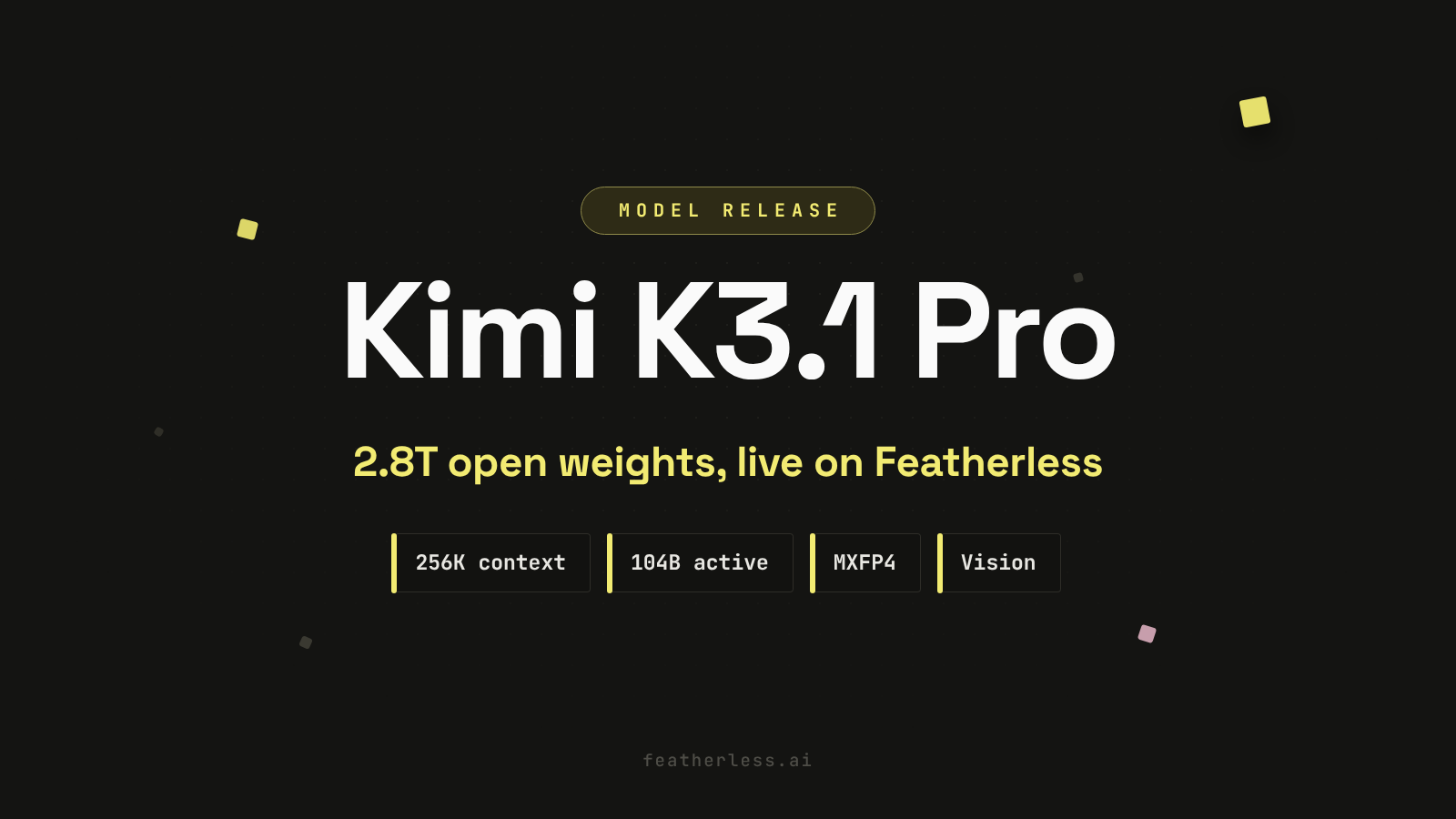
Moonshot published the Kimi K3.1 Pro weights on November 4, twelve days after the model went live on its own API. It is a 2.8 trillion parameter mixture-of-experts model, 104 billion active per token, with native image input and a 1,048,576 token context window.
Kimi K3 has been live on Featherless since July, and K3.1 Pro joins it on the same OpenAI-compatible API, the same key, and the same catalog of 40,000+ open models, with no logging of prompts or completions.
What changed from Kimi K3
Kimi K3.1 Pro is post-trained from Kimi K3, so the headline sizes carry over unchanged: 2.8 trillion total parameters, 104 billion active per token, 93 layers, and 16 of 896 experts routed per token with two shared.
The attention stack is where the work went. K3 interleaved Kimi Delta Attention with full-attention Gated MLA layers. K3.1 Pro keeps the 69 KDA layers and swaps the 24 full-attention layers for Gated DeepSeek Sparse Attention, whose indexer runs 32 heads at dimension 128 and selects a top-K of 2,048 keys. Those 24 layers were the ones whose cost grew with the whole sequence, so replacing them is what brings a million-token window within reach of a servable price.
The second change is training rather than architecture. Moonshot describes large-scale joint reinforcement learning across hundreds of downstream domains, and the gains concentrate in long-horizon agentic work rather than single-turn knowledge.
Vision carries over from K3 through the same MoonViT-V2 encoder, 401 million parameters, text and images in and text out. The weights ship in MXFP4 with MXFP8 activations, the precision Moonshot trained the model to serve at rather than a community quantization applied afterwards.
The numbers
Moonshot’s model card runs the comparison against Claude Opus 5.5, GPT-6 Astra, Claude Fable 5.1, DeepSeek-V4.1-Flash and GLM-5.3. The table below takes seven rows from it and keeps GLM-5.3 in the last column as the open-weights comparison.
| Benchmark | Kimi K3.1 Pro | Claude Opus 5.5 | GPT-6 Astra | GLM-5.3 |
|---|---|---|---|---|
| Terminal-Bench 4.0 | 65.7 | 66.4 | 58.2 | 41.8 |
| SWE Marathon v1.1 | 51.7 | 46.3 | 42.5 | 42.5 |
| HLE-Full with tools | 70.0 | 67.7 | 57.2 | 62.5 |
| BrowseComp | 92.1 | 90.8 | 91.5 | — |
| GPQA-Diamond | 94.2 | 93.9 | 96.1 | 91.7 |
| Program Bench | 31.5 | 65.0 | 50.0 | 19.0 |
| HLE-Diamond | 39.4 | 60.9 | 65.8 | 25.1 |
K3.1 Pro takes SWE Marathon by five points over Opus 5.5, leads HLE with tools, and edges BrowseComp. Against GLM-5.3 the gap on long-horizon coding is more than twenty points.
Opus 5.5 doubles it on Program Bench, 65.0 against 31.5. GPT-6 Astra takes HLE-Diamond 65.8 against 39.4, and Terminal-Bench-Science 68.1 against 38.1. Single-turn reasoning at the hardest end is still closed-source territory.
Every figure in the table is Moonshot’s own reporting. The K3.1 Pro column was measured at Moonshot’s maximum reasoning setting, temperature 1.0 and top-p 0.95, and the rival columns are lifted from each vendor’s published results on different agent harnesses, which the card says outright. Scores from different harnesses are not strictly comparable.
Moonshot removed hacking-related training data before publishing the weights, and reports that an uncut version solved 90.5% of its internal exploit benchmark against 81% for the model it shipped. Kimi K3 solved 33.3% of the same set, so the newer model is far more capable here even after the cut. On the public ExploitBench the released model scores 74.7, behind Opus 5.5 at 91.0. Those cyber scores are a deliberate reduction rather than a capability ceiling.
How to run Kimi K3.1 Pro
Currently on Featherless, Kimi K3.1 Pro serves at 256K context, MXFP4 quantization, vision enabled. The model’s native window is 1,048,576 tokens, and we’re working to expand ours toward it.
Kimi K3.1 Pro runs on the same LLM calling API developers already know and use, the OpenAI-compatible API. It’s the same as the other 40,000+ models we host on our site.
from openai import OpenAI

client = OpenAI(
    base_url="https://api.featherless.ai/v1",
    api_key="YOUR_FEATHERLESS_KEY",
)

response = client.chat.completions.create(
    model="moonshotai/Kimi-K3.1-Pro",
    messages=[
        {
            "role": "user",
            "content": (
                "I'm building a URL shortener that needs to handle 5,000 new links "
                "per second. Should I store them in Postgres or Redis? Weigh "
                "durability, cost and operational complexity, then pick one and "
                "explain why in under 150 words."
            ),
        }
    ],
)

print(response.choices[0].message.content)
On multi-turn work, pass the whole assistant message back rather than the content alone. Dropping the reasoning block between turns is the usual reason a model performs worse in your harness than it does on the leaderboard.
On the Developer plan it bills at $2 per million input tokens, $0.20 cached and $10 per million output, the same rate Moonshot charges on its own API. Cached input is a third cheaper than Kimi K3 on Featherless, which bills $0.30, and on agent loops that resend a long system prompt every turn that is the line that moves the bill. Tokenomics 101 covers the arithmetic.
And, as is the same with all of your api calls on featherless, no logs, so your prompts and completions stay yours.
Try it out today – https://featherless.ai/models/moonshotai/Kimi-K3.1-Pro
Going beyond
Are you interested in running Kimi K3.1 Pro at even larger scales, or at its full 1M context? Are your unpredictable per-token bills exploding? Check out our dedicated gpu clusters, where our team can help tune the full inference stack exactly for your needs, including quantization, batching, fine-tuning, and whatever else you need. We have GPUs, and you need compute. Learn more below, and feel free to schedule a call, where we’ll help tackle your biggest AI problems.
We moved one customer’s agent workload from Opus to dedicated GLM 5.2 on AMD MI325X and took their $150K monthly bill to $7.6K.
Talk to us about dedicated GPUs → https://featherless.ai/platform/dedicated-private-inference
Kimi K3.1 Pro FAQ
Is Kimi K3.1 Pro open source? Open-weight. The weights are on Hugging Face under the Kimi K3.1-Pro License, which is Moonshot’s own license rather than an OSI-approved one. It permits commercial use with conditions, the main one being that reselling inference access above $20 million in group revenue needs a separate agreement with Moonshot. Internal use and products that embed the model in a feature are exempt. The training data and recipe are not public.
Can I run Kimi K3.1 Pro locally? Realistically, no. The weights are about 1.56TB across 96 shards, and the floor is a tensor-parallel group of eight B300-class accelerators. An 8xH200 node does not have the memory for the weights alone. We walk through the hardware requirements for running Kimi locally in more detail.
What context window does Featherless serve? 256K on the Developer plan. The model’s native window is 1,048,576 tokens, and the full window is available on a dedicated instance.
How much does it cost on Featherless? $2 per million input tokens, $0.20 per million cached input, $10 per million output. That matches Moonshot’s own API rate, and the cached rate is a third below Kimi K3 on Featherless.
How is it different from Kimi K3? Same size and same expert routing. K3.1 Pro replaces K3’s 24 full-attention layers with Gated DeepSeek Sparse Attention and adds large-scale reinforcement learning across hundreds of downstream domains, which is where Moonshot puts the gain on long-horizon agentic work.
Related articles
Start building under 3 minutes